Alex Petrov's Professional Home Page
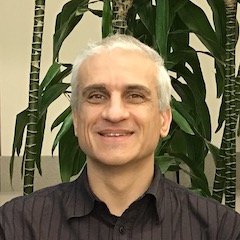
Dr. Alexander A. Petrov
Associate Professor
Laboratory for Cognitive Modeling and Computational Cognitive Neuroscience
Department of Psychology
Courtesy affiliation with the
Department of Philosophy
Ohio State University
200B Lazenby Hall
1827 Neil Avenue
Columbus, OH 43210
Email: apetrov [at] alexpetrov [you know what]
WWW:
http://alexpetrov.com/
Welcome and thanks for stopping by!
The lab is recruiting new applicants for the 2024/2025 academic year.
See the Teaching page for details.
Research Interests
I am a cognitive scientist. My research interests include:
- Relational reasoning, analogy-making, and high-level cognition. I am particularly interested how such high-level tasks, which require role-filler binding, can be implemented in biologically realistic neural networks. In the words of my former advisor John Anderson (and Allen Newell before him), How can the human mind occur in the physical universe? My specific interest is in human -- that is, relational -- cognition.
- Visual cognition, particularly the extraction and encoding of relations among two or more objects in a visual scene. Again, I am particularly interested in biologically plausible models of the underlying neural mechanisms.
- Philosophy of perception. Naturalistic accounts of mental content.
- Spatial vision, visual perceptual learning, and neural-network models thereof.
- Cognitive architectures, specifically ACT-R, Leabra, and Nengo.
Methodologically, research in my lab involves a combination of behavioral and psychophysical experimentation, mathematical and computational modeling, eyetracking, pupillometry, and philosophical reflection. Typically, the papers that we publish involve both empirical data and computational models. We also use and develop sophisticated models to analyze the behavioral data collected in the lab or in collaboration with other labs.
Announcements
Congratulations to Yuhui (Ava) Du for defending her Ph.D. Thesis (21 Aug, 2023)!
Former student Ying Yu received the Eearly Career Advancement Prize by the Editors of i-Perception for her paper (Yu, Petrov, & Todd, 2021).
Congratulations to Ying Yu for defending her Ph.D. Thesis (14 June, 2020)!
The Interdisciplinary Workshop on the Philosophy and Psychology of Visual Space (15-16 Feb 2019) was a great success. Thanks to all speakers and participants. Video recordings of most of the talks are available on YouTube.
Our paper (Sawada & Petrov (2017)) received the Fred Brown Research Award for 2017. The award singles out one journal article each year among all publications (co)authored by faculty members of the Department of Psychology at OSU in that year.
The Matlab implementation of the Divisive Normalization Model is now available on GitHub. A YouTube podcast is also available. See Sawada & Petrov (2017) for the journal article.
Our paper (Hayes & Petrov, 2016a) received the Best Article of the Year award for Behavior Research Methods in 2016.
Selected Publications
A complete list of
publications (as of July 2022) is available separately, organized by outlet type or in
reverse chronological order.
My curriculum vitae
is also available (pdf).
- Yu, Y., Petrov, A. & Todd J. T. (2021)
- Bilateral symmetry has no effect on stereoscopic shape judgments.
i-Perception, 12 (4), 1-18,
DOI: 10.1177/20416695211042644.
Award: Eearly Career Advancement Prize
Abstract Reprint (pdf) Companion article 1 Companion article 2 - Sawada, T. & Petrov, A. (2017)
- The divisive normalization model of V1 neurons: A comprehensive
comparison of physiological data and model predictions.
Journal of Neurophysiology, 118 (6), 3051-3091.
doi: 10.1152/jn.00821.2016.
Award: Fred Brown Research Award of the OSU Department of Psychology.
Abstract Reprint (pdf) Software (on GitHub) YouTube podcast Companion article - Hayes, T. & Petrov, A. (2016a)
- Mapping and correcting the influence of gaze position on pupil size measurements.
Behavior Research Methods, 48 (2), 510-527.
Award: Best Article of the Year.
Abstract Reprint (pdf) - Hayes, T. & Petrov, A. (2016b)
- Pupil diameter tracks the exploration-exploitation tradeoff during
analogical reasoning and explains individual differences in fluid intelligence.
Journal of Cognitive Neuroscience, 28 (2), 308-318.
Abstract Reprint (pdf) - Hayes, T., Petrov, A. & Sederberg, P. (2015)
- Do We Really Become Smarter When Our Fluid-Intelligence Test Scores Improve?
Intelligence, 48 (1), 1-14.
Abstract Reprint (pdf) Companion article - Petrov, A. & Hayes, T. R. (2010)
- Asymmetric transfer of perceptual learning of luminance- and
contrast-modulated motion.
Journal of Vision, 10 (14:11), 1-22,
http://www.journalofvision.org/10/14/11/.
Abstract Reprint (pdf) Matlab reports (html) - Petrov, A. (2009)
- Symmetry-based methodology for decision-rule identification
in same-different experiments.
Psychonomic Bulletin & Review, 16(6), 1011-1025.
Abstract Reprint (pdf) - Petrov, A., Dosher, B., & Lu, Z.-L. (2005)
-
The Dynamics of Perceptual Learning: An Incremental Reweighting Model.
Psychological Review, 112(4), 715-743.
Abstract Reprint (pdf) Data sets Software - Petrov, A. & Anderson, J. R. (2005)
-
The Dynamics of Scaling: A Memory-Based Anchor Model of
Category Rating and Absolute Identification.
Psychological Review, 112(2), 383-416.
Abstract Reprint (pdf) Software - Kokinov, B. & Petrov, A. (2001)
- Integrating memory and reasoning in analogy-making: The AMBR model.
In D. Gentner, K. Holyoak, & B. Kokinov (Eds.),
The analogical mind: Perspectives from cognitive science
(pp. 59-124). Cambridge, MA: MIT Press.
Abstract Excerpts Preprint (pdf)
Branching Out
My teaching home page provides access to course syllabi, reading assignments, presentation slides, and various student resources.
A sizable portion of this site is devoted to assorted ideas of general interest: philosophy, humanism, politics, science, astronomy, aikido, ... Life is so interesting and deep, check it out!
My personal home page was meant to publish photos of my daughter and wife for the benefit of my extended family in Bulgaria. This idea, however, was made obsolete by the advent of Facebook. You are welcome to visit us at http://www.facebook.com/alexander.petrov1969


